

Beyond Good and Evil
Ignorance as the Root

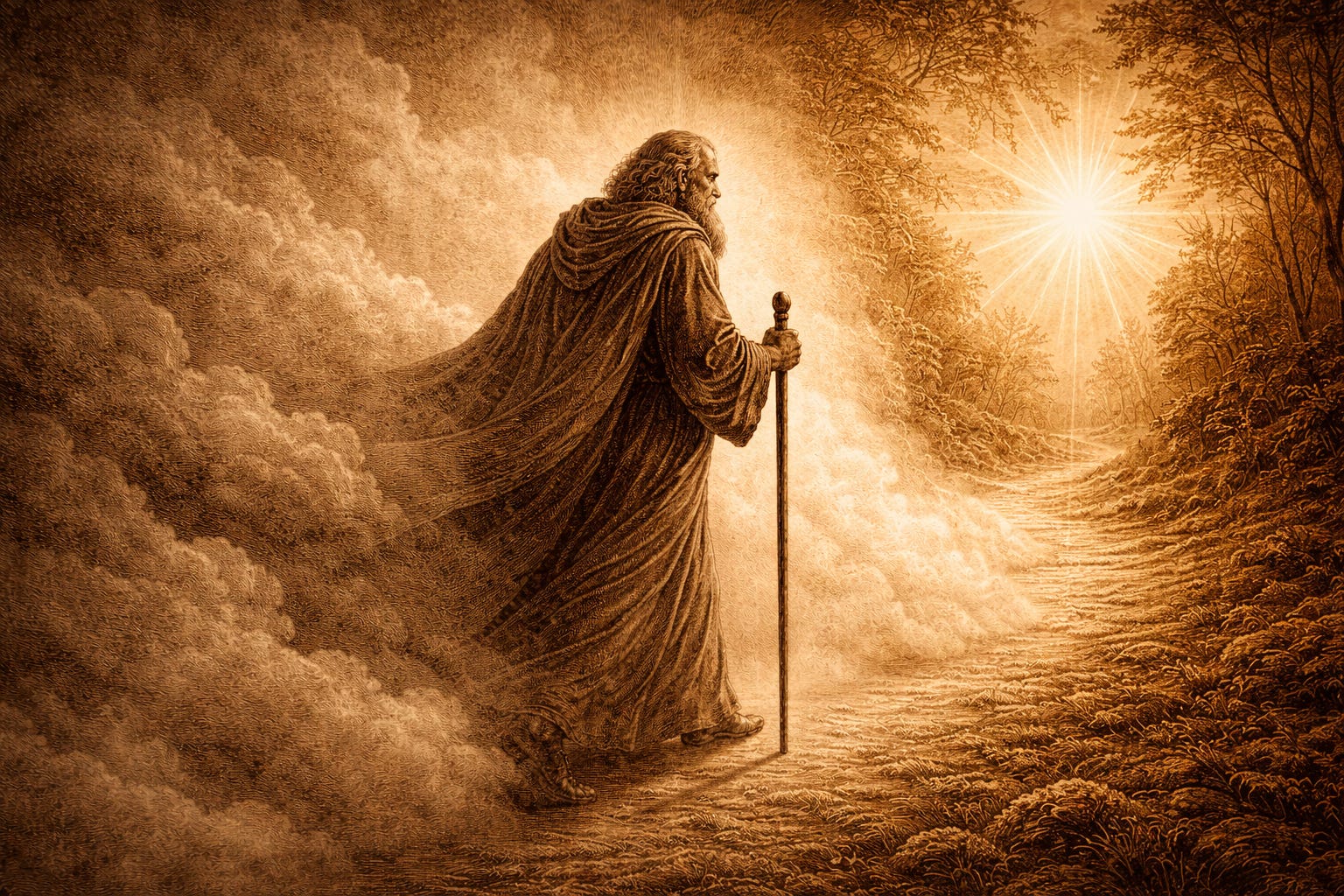
Note on Sources: This essay explores the nature of evil and suffering through the Gospel of Truth, an early Christian text discovered at Nag Hammadi in 1945 that frames human suffering as cognitive rather than moral. The Corpus Hermeticum (2nd-3rd century CE texts), particularly Book X and Book XIII, reveals that the soul's vice is ignorance rather than moral corruption. Neoplatonic philosophy (3rd-6th century CE) demonstrates how suffering arises from identifying with lower levels of emanation while forgetting one's true nature. Carl Jung's depth psychology demonstrates how unconscious patterns create suffering mechanically, without moral judgment. The Gospel of Thomas speaks of waking from a nightmare rather than being punished for sin. Together, they reveal a framework where evil arises not from moral failure but from not-knowing, and where the solution is therefore gnosis rather than redemption.Originally written in Swedish; translated and edited for clarity in English.
A woman loses everything to addiction.
Family, career, health, dignity, all consumed by compulsive patterns she seems unable to stop. When she finally hits the bottom, the question that tortures her is: “Why am I like this? What’s wrong with me?”
A man destroys his third marriage through the same patterns that destroyed the first two. Defensiveness, withdrawal, the inability to be vulnerable. He knows intellectually what he’s doing wrong. He’s read the books, been to therapy, genuinely wants to change. The pattern repeats anyway. He concludes he must be broken, fundamentally defective, undeserving of love.
We frame these situations morally. Good people and bad people. Right choices and wrong choices. Virtue rewarded, vice punished. It has always bothered me, this view of the universe as a moral ledger where suffering is either deserved punishment or mysterious injustice. And this framework is so deeply embedded in Western consciousness, particularly Christian-influenced consciousness, that we rarely question it.
I've watched this pattern my whole life. People suffering, blaming themselves, locked in shame. And I kept thinking: what if the entire framework is wrong?
What if evil and suffering don’t arise from moral failure at all? What if they’re cognitive? The natural consequence of not-knowing rather than the just punishment for wrongdoing? Uncomfortable idea. It strips away the reassuring structure of moral cause and effect, it means you can’t earn safety through being good and it means suffering lacks necessary meaning and it also means the cosmos doesn’t care about your ethical quality.
And yet, if evil arises from ignorance rather than moral corruption, the path forward transforms completely. Gnosis. Direct knowledge of how reality actually works. No redemption. No punishment and forgiveness. No moral striving to become worthy.
The Cognitive Origins of Suffering
When I first read this in the Gospel of Truth, it stopped me cold: “Ignorance of the Father brought about anguish and terror; and the terror grew solid like a fog so that no one was able to see. For this reason error became powerful.”
Read that sequence carefully.
Notice what it doesn’t say. No mention of sin bringing punishment. No wickedness bringing suffering. Just ignorance, not-knowing, bringing about anguish and terror. The suffering arises directly from the state of not-knowing, not imposed externally as consequence for wrongdoing.
Then notice what happens: the terror grows solid. Dense, fog-like, obscuring. And in that obscured state, error becomes powerful.
Error. Mistakes based on not seeing clearly. Patterns based on misunderstanding, actions arising from confusion rather than malice. Ignorance creates fear, fear creates opacity, opacity leads to error, error perpetuates suffering. The cycle operates mechanically.
The text continues with an image anyone who has suffered anxiety or depression will recognize: “This is the way they were in ignorance, as if sunk in sleep and found themselves in disturbing dreams. Either there is a place to which they are fleeing, or they are struck powerless, or they are receiving blows... When those going through all these things wake up, they see nothing.”
We are asleep.
Dreaming nightmares we take for reality. The suffering feels utterly real while we’re in it. The threats seem genuine. The blows are experienced as actual. But the awakened perspective reveals that we were dreaming, operating in a state of not-knowing, reacting to phantoms, suffering from confusion. The resolution comes through waking up, through seeing clearly enough to recognize what was never actually there, rather than through becoming good enough to deserve relief.
The Soul’s Vice
Book X of the Corpus Hermeticum identifies the root even more directly: “And the soul’s vice is ignorance.”
Not greed. Not lust. Not pride or wrath or any of the traditional moral failings.
Ignorance. The soul’s fundamental problem: it doesn’t know. And because it doesn’t know, it operates blindly, creating suffering through mechanical consequence rather than deserving suffering through moral failure.
The text continues: “For that the soul who hath no knowledge of the things that are, or knowledge of their nature, or of Good, is blinded by the body’s passions and tossed about. This wretched soul, not knowing what she is, becomes the slave of bodies of strange form in sorry plight, bearing the body as a load; not as the ruler, but the ruled.”
The soul suffers because it doesn’t know what it is.
In the Hermetic and Neoplatonic framework, the soul is psyche: the intermediate level of emanation between divine intellect (nous) and matter (soma). When the soul doesn’t know this, when it identifies only with the lowest level, it becomes vulnerable to being controlled by patterns it doesn’t recognize, driven by forces it doesn’t understand. Becomes “the ruled” rather than “the ruler”, through lack of knowledge.
The framework transforms completely. The woman suffering from addiction operates in ignorance of the actual patterns driving her behavior: patterns at the psyche level she hasn’t brought to consciousness. The man destroying his marriages lacks knowledge of the unconscious dynamics controlling him from levels he doesn’t perceive.
The solution shifts from “be better” to “see clearly.” From moral striving to cognitive clarity, from deserving redemption to achieving gnosis.
Book XIII describes the process of transformation: regeneration through knowledge rather than punishment and forgiveness. The soul needs to wake up. To see what it is, to know itself. Through that knowledge, transformation happens naturally, automatic consequence of clear seeing.
The Mechanical Nature of Unconscious Patterns
Jung understood something I'd experienced but couldn't name. He observed that unconscious patterns operate mechanically, without moral consideration.
Consider his most famous formulation: “Until you make the unconscious conscious, it will direct your life and you will call it fate.”
Notice what’s absent from that statement: any mention of deserving, moral quality, punishment, or reward. The unconscious directs your life because it’s unconscious. Make it conscious, and its mechanical control dissolves, through awareness.
Jung documented this extensively in his work with patients. A man would recreate the same destructive relationship pattern throughout his life, over and over, year after year, because an unconscious pattern, perhaps originating in childhood, perhaps archetypal material from the World Soul level, operated automatically when certain conditions triggered it.
The man’s conscious intentions, his genuine desire to change, his moral quality? None of that mattered. The unconscious pattern ran its course with mechanical inevitability.
The solution? Consciousness. Bringing awareness to the pattern. Understanding its origins, recognizing its triggers, seeing it operate, and through that seeing, the pattern loses its autonomous power. Because consciousness illuminates what was operating in darkness.
Jung’s exploration of the shadow revealed the same principle. The shadow: what you don’t know about yourself. The parts you’ve denied, repressed, refused to acknowledge. These denied contents don’t disappear. They operate from the unconscious, from the psyche level you haven’t integrated. Creating effects you don’t understand, driving behaviors you don’t recognize as yours.
The person who denies all anger becomes prone to sudden explosions or passive-aggressive patterns, because the denied anger operates mechanically from the unconscious psyche level.
The person who rejects all “negative” emotions finds them leaking out in symptoms, illness, or projected onto others. Mechanical consequence of not-knowing.
Jung offered active imagination, shadow integration, making the unconscious conscious. Pure gnosis in psychological language, ascending from identification with surface consciousness to integration of the psyche level to access to the nous level.
What You Don’t Bring Forth
The Gospel of Thomas states this with brutal directness: “If you bring forth what is within you, what you have will save you. If you do not have that within you, what you do not have within you will kill you.”
What’s within you, already present at the psyche and nous levels you contain as a microcosm, must be brought forth into consciousness.
If you do this, it saves you. If you don’t bring forth what’s within, if you keep it repressed, denied, unconscious, it will kill you. Natural consequence of remaining ignorant of the forces operating within your own emanation structure.
The woman with addiction has patterns within her, trauma responses at the psyche level, emotional regulations learned in childhood, biochemical vulnerabilities, operating unconsciously. Psychological realities, autonomous forces at levels she hasn’t integrated. If she brings them forth into consciousness, works with them, understands them, they become workable. She’s transformed through knowing what was previously unknown.
If she doesn’t bring them forth, if she continues operating in ignorance, believing the problem is moral weakness requiring more willpower, the patterns continue operating mechanically from the unconscious psyche level.
She tries to white-knuckle her way through from conscious will alone, fails because will operating at one level can’t control patterns operating at another level she hasn’t accessed, concludes she’s fundamentally bad. The ignorance deepens, the fog grows more solid, the error becomes more powerful.
The man destroying marriages has within him unconscious patterns of attachment at the psyche level, defenses learned early, perhaps archetypal father-wound material from the World Soul level. Psychological structures requiring consciousness. Bring them forth, understand them, integrate them. And they lose their mechanical power to recreate the same destruction. Leave them unconscious at the psyche level, and the pattern repeats regardless of conscious intention or moral quality.
Thomas describes psychological law in a cosmos structured by emanation. What operates unconsciously at lower levels controls you. What becomes conscious can be worked with.
The Nightmare and the Awakening
The Gospel of Truth’s metaphor of sleep and nightmare captures this perfectly.
You’re having a disturbing dream. In the dream, the threats are real, the fear is genuine. You might be fleeing something terrible. You might be powerless against forces attacking you.
All of it feels utterly real while you’re asleep.
The moral framework within the dream might be elaborate, perhaps you deserve this suffering for some transgression or perhaps you’re being tested. Then you wake up. And you see: there was nothing there. The threats were dream-images. The punishment was a nightmare. The moral framework, the entire structure of deserving and earning and sin and redemption, was part of the dream itself.
The Gospel of Truth says explicitly: “When those going through all these things wake up, they see nothing.”
Not “they see they’ve been forgiven” or “they see they’ve become worthy.” They see nothing. The entire framework dissolves.
Gnosis offers waking up from the dream entirely. Seeing that the framework of moral cause-and-effect, of deserving suffering and earning relief, was part of the ignorance itself. In the Hermetic and Neoplatonic framework, this means recognizing yourself as a microcosm containing all levels of emanation. You’re not just soma (body). You contain psyche (soul) and nous (divine intellect).
Identifying only with the lowest level: the sleep. Recognizing the full structure: the awakening.
Book X describes this transformation: the soul that gains knowledge transcends being subject to the mechanical patterns that previously controlled it. Through gnosis: direct knowledge of what it actually is beyond the dream-identities it took for real.
Beyond Moral Frameworks
When I first understood that evil arises from ignorance rather than moral corruption, it upended everything I’d been taught about suffering. Several things follow from this, things that change how we should respond to people in pain.
First, judgment becomes useless. The person creating suffering through their unconscious patterns: asleep, identified with lower levels while higher levels remain unconscious. Judging them morally doesn’t help them wake up. It might actually deepen their ignorance by reinforcing the false framework that sees everything through moral cause-and-effect.
Second, shame and guilt lose their supposed usefulness.
These emotions arise from the assumption that you’re morally defective, that you deserve suffering. But if the actual problem is ignorance: not knowing the levels you contain, operating from identification with soma alone while psyche and nous remain unconscious. Then shame is worse than useless. An additional layer of fog obscuring clear seeing.
Third, the solution shifts entirely. Seeing clearly rather than being better. Achieving knowledge rather than earning worthiness. Cognitive awakening rather than moral striving, ascent through levels of emanation rather than punishment and redemption.
I’ve watched people destroy themselves while everyone around them, including me, kept telling them to try harder, be stronger, make better choices. But the woman with addiction isn’t failing morally. She’s operating unconsciously, driven by patterns at the psyche level she hasn’t brought into awareness. And that changes everything about how we should respond to suffering.
The man destroying his relationships needs to make conscious the unconscious patterns controlling him from the psyche level. Once conscious, they can be worked with, integrated and transformed. Natural consequence of illuminating what was dark.
Ethics still matter. Actions have consequences. But the framework shifts from moral judgment to mechanical understanding.
You don’t suffer because you deserve it. You suffer because specific causes at specific levels of emanation produce specific effects, and if you don’t understand the causal chain operating through the levels you contain, you remain subject to it.
The Transformation Through Knowledge
Book XIII of the Corpus Hermeticum describes regeneration: The soul’s transformation through knowledge.
Sudden cognitive shift. Waking up from the dream. Seeing clearly what was obscured. The text describes transformation happening when ignorance is replaced by knowledge, with behavioral change following automatically. When you see clearly, when you recognize yourself as a microcosm containing all levels rather than identifying only with soma. You act differently, because you’re no longer operating in confusion about what you are.
Jung observed the same phenomenon.
Patients who achieved genuine insight into their unconscious patterns didn’t need to struggle to change behavior. The behavior changed naturally. The pattern that previously had mechanical control from the unconscious psyche level lost that control through being seen, integrated, brought to consciousness. Through consciousness itself.
Gnosis in practice. Direct knowledge of how your consciousness actually operates through the levels you contain. That knowledge itself is transformative, because ignorance and knowledge are incompatible states.
One or the other.
The Gospel of Truth describes those who receive gnosis as immediately freed from the nightmare. Immediately, through seeing. The fog disperses not gradually but all at once when consciousness illuminates what was dark.
In Neoplatonic terms, this is the soul recognizing it participates in higher levels of emanation. Not just psyche floating inside a void. Psyche that emanates from and participates in Nous, connected to THE ALL through the very structure of reality.
That recognition shifts everything.
Living Beyond Good and Evil
The title of this essay deliberately echoes Nietzsche, who understood that morality itself can be a form of ignorance, a framework we project onto reality that obscures rather than illuminates.
But the gnostic and Hermetic texts go further. They’re not replacing one moral system with another. They’re pointing beyond moral frameworks entirely, toward direct knowledge of how consciousness operates through levels of emanation.
This doesn’t mean “anything goes.” Actions still have consequences. Patterns still create suffering. The cosmos is ordered, Asclepius is clear that “nothing is separate from the system of order.”
But the framework for understanding suffering shifts from “you're being punished for being bad” to “you're experiencing mechanical consequences of operating in ignorance of the levels you contain.” The difference is everything, and I mean that literally. I spent years trapped in the first framework, convinced my suffering meant I was fundamentally defective. Punishment requires moral reformation. Mechanical consequence requires understanding. One keeps you trapped in shame and striving. The other points toward gnosis as the actual solution.
When you stop judging yourself morally and start understanding yourself mechanically, transformation becomes possible. I'll be honest, this shift took me years. The real causes operating at different levels of emanation, the mechanical operations of consciousness moving through the levels you contain as a microcosm. Transformation becomes possible, because knowledge dissolves ignorance.
Book X promises that the soul transformed through gnosis ascends, because ignorance was what bound it to identification with lower levels, and knowledge is what frees it to recognize the higher levels it also contains.
The mechanism is automatic. Wake up from the dream, and the dream dissolves. Recognize yourself as a microcosm containing all levels, and identification with the lowest level alone becomes impossible.
The kingdom spreads upon the earth, but you don’t see it because you’re operating in ignorance, in the fog, in the nightmare, in the moral framework that itself obscures. Gnosis doesn’t make you worthy of seeing the kingdom. It removes the obscuration that prevented seeing what was always already there, always already present in you as the nous level you contain but haven’t recognized.
Beyond good and evil. Recognizing that the root of suffering is cognitive. The solution: waking up. Recognizing the levels you contain, ascending from identification with soma alone to integration of psyche to awareness as nous.
The nightmare continues as long as ignorance persists. Knowledge ends it, not gradually, not after you’ve earned it, but immediately through direct seeing.
Gnosis. Cognitive awakening. Achieving knowledge of what was always already the case.
The work: seeing clearly. And seeing clearly, you discover you were never unworthy. You were just asleep, identified with the lowest level, unaware of the divine intellect you contain.
You wake up.
And waking, you see nothing of the moral drama, nothing of the punishment and reward. Just the emanation structure you always were, now recognized, now conscious, now free.
I am a gnostic but yet recognizing ones faults doesn't necessarily eliminate it. I think this article rather good ignores its issues.
Lets say a person has a mental predisposition to anger. Recognizing doesn't change biology. Can we have a different perspective that a persons sins is because they are living in a flaw world?