

Katabasis
The Descent Into Hades

Note on Sources: This essay explores katabasis (ritual descent to the realm of the dead) as practiced by pre-Socratic philosophers and later Neoplatonists, drawing from Homer’s Odyssey Book 11 (8th century BCE) which provides the earliest detailed Greek account, the poems and fragments of Parmenides and Empedocles (5th century BCE) who documented their own descents, Plato’s Republic and Symposium (4th century BCE) which reframed katabasis philosophically, and Iamblichus’ De Mysteriis (4th century CE) which argued that philosophers require ritual practice beyond pure contemplation. Carl Jung’s active imagination technique (20th century) provides modern empirical validation for psychic dimension navigation. Together these sources reveal that what modern scholarship treats as metaphor was actual practice with consistent phenomenology.Originally written in Swedish; translated and edited for clarity in English.
Before Plato used descent as a philosophical allegory Greek philosophers practiced actual katabasis. A psychic descent into the land of the dead. Mystery schools used to teach and practice systematic descent for centuries before the era of Athenian rationalism buried it under abstraction.
The practice is documented in Homer’s Odyssey and Iamblichus would later try to revive the ritual side of philosophy and this revival could arguably be claimed to include katabatic elements. Modern scholars treat this as superstition but the instructions are detailed and still accessible.
Homer’s Evidence
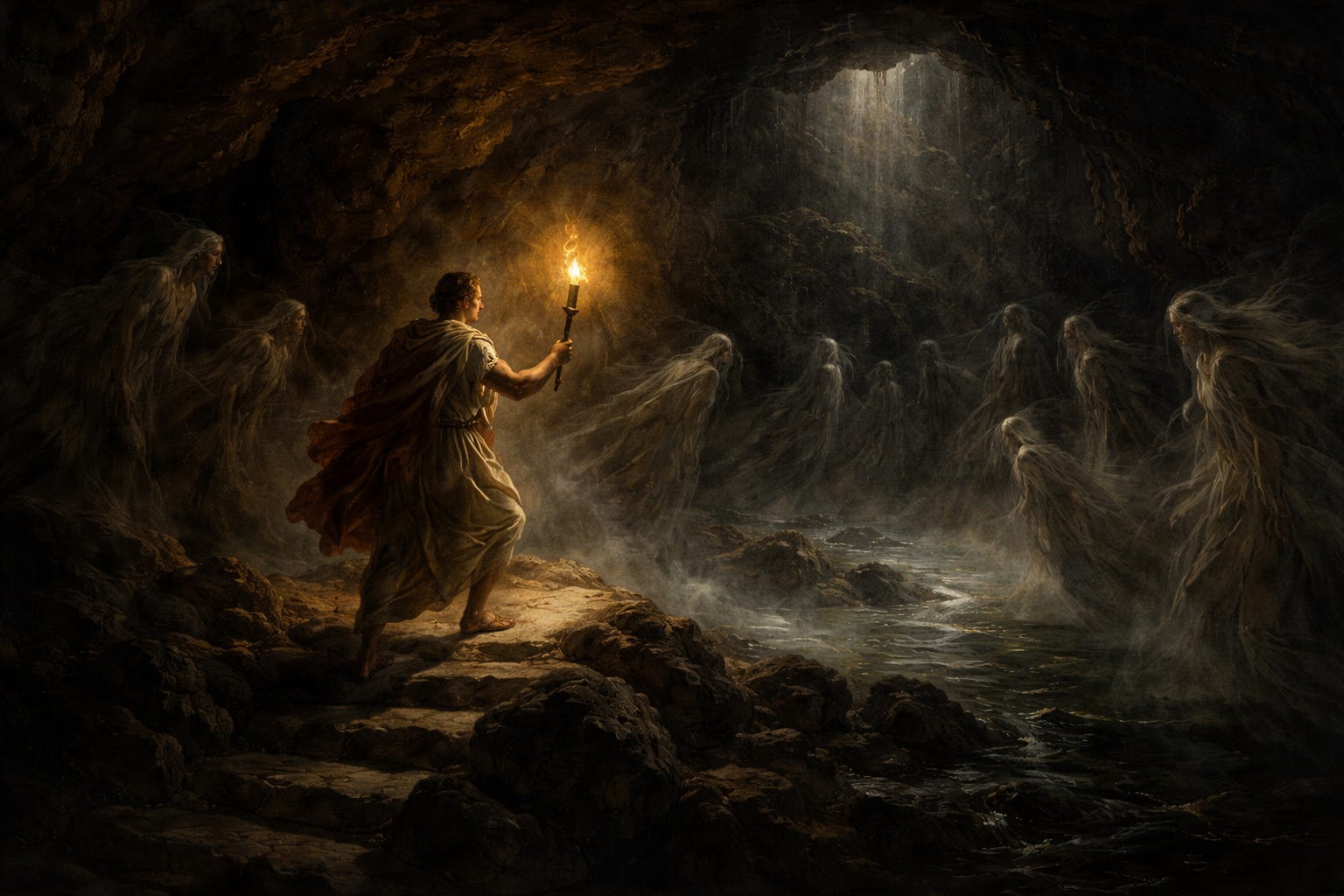
The earliest account we know of today is found in Homer’s Odyssey Book 11 where Odysseus descend into Hades to receive prophecy from the blind seer, Teiresias. Homer writes that “to Hades no man ever yet went in a black ship.” This has been interpreted as something along the lines of you can’t navigate there the same way you move through material space.
The goddess Circe is the one who provides him with the instructions that help him orient his consciousness in preparation for the journey.
Most of the inhabitants of Hades are described as shades who “flit about as shadows.” Like capturing motion at a low framerate where the silhouette leaves a trail briefly after passing.
But Teiresias is the exception to this rule. “He alone should have understanding. Persephone has granted reason to him.” This is because Teiresias practiced divination and navigated the psychic dimension consciously while he was alive. And when he died nous remained active. What is meant by Persephone’s “granting” was a recognition of the preparation that he did while he was still alive.
Pre-Socratic Practitioners
Parmenides begins his poem with an explicit account of katabasis and writes “The mares that carry me as far as longing can reach rode on.” The use of passive language repeats in the poem and points to the fact that he doesn’t move himself but is transported by outside forces to the House of Night far below the center of the earth, where he receives the gift of logic by a goddess.
Modern scholarship struggles with this as Parmenides is hailed as the father of rational philosophy. Because how could Logic come from a descent into the underworld? But as the research by Peter Kingsley describes: Parmenides was associated with the iatromantis, the seers who received wisdom and truth from the god Apollo and this is the practice that this poem is describing. The original poem is a direct account of altered states of consciousness and descent into the underworld, this however is something that the rationalists would later reinterpret.
Also Empedocles hints at direct experience when he writes “I wept and wailed when I saw the unfamiliar place.”
What Actually Happens
Spacial physics works in reverse within the psychic dimension. While material space is fixed and you move through it, psychic space moves around you while you are fixed in place.
This explains Parmenides’ use of passive language and why Odysseus’ ship is unable to reach it.
You don’t move through the cave, the cave moves past you and you are transported deeper without voluntary movement. This reversal is what Circe’s instructions prepared Odysseus for.
The reader might wonder why I choose to refer to it as the psychic dimension rather than the spiritual, this is because the Greeks didn’t have a clean separation between these concepts like we do today. The Greek word Psyche (ψυχή) meant soul, spirit, breath, life, and consciousness simultaneously. So what we call “psychological” and what we call “spiritual” were the same territory at different depths.
From Philosophy to Ritual Recovery
Plato recognized the practice of katabasis but transformed it into a dialectical method where philosophers need to descend back into the cave to help those who are trapped in the shadows. This is sophisticated but works entirely through reasoning and leaves out the ritual component.
But Iamblichus saw what was lost in the process and challenged both Plotinus and Porphyry who argued pure contemplation was sufficient for union with the divine. In De Mysteriis he insisted philosophers need the ritual practice.
“It is not pure thought that unites the theurgists to the gods,” he wrote. “It is the accomplishment of acts not to be divulged and beyond all conception, and the power of unutterable symbols, understood solely by the gods, which establishes theurgic union.”
Contemplation prepares you but actual union requires ritual engagement. Theurgy includes katabatic elements because it requires the soul to engage with the psychic dimension directly and not just thinking about it.
Iamblichus contradicted Plotinus who claimed that part of our souls remains in the intelligible realm, for Iamblichus we’re fully embodied and therefore we need ritual practices that work through both the body and psyche. Theory alone is not enough to accomplish what requires embodied engagement.
Modern Access
Carl Jung’s technique of active imagination can access katabatic territory when properly used. The principles match what the ancient practitioners required; space moves around you rather than you moving through space. Passive transportation rather than active movement and engagement with Autonomous contents that have their own intelligence.
Jung documented the collective unconscious where autonomous psychic contents appear across different cultures and archetypes manifest without individual construction. The psychic dimension has structures you discover through practice rather than create through imagination.
When active imagination is used to go deep enough the territory can become recognizable from Homer’s descriptions. Shades move around independently with their own purpose and where forms trail after movement. Not every practice reaches this deep but the technique can provide this kind of access when the consciousness is properly prepared.
Why It Matters
Mystery schools trained katabasis to prepare their initiates for death. When the body dies the psychic dimension remains accessible. Those who practiced navigating this dimension during their lifetime retain understanding after death while the unprepared flit about as Shadows without understanding.
So if you practice navigating the psychic dimension, consciousness knows the territory when death forces these conditions permanently.