
The Forgotten Third

All spiritual traditions offer some kind of tools, mostly it comes down to a combination of mostly three practices, prayer, rituals or meditation. These are instruments that seekers use to approach the deeper structures of consciousness along with libraries filled with guides on how to use them. People spend their entire lifetimes on perfecting a meditation posture or learning the correct sequence of a liturgy.
And at the same time every human being on earth spends about a third of their existence in an altered state of consciousness and almost nobody thinks it deserves a second thought.
You will dream tonight. When you lay down to sleep your social identity that you have spent so much time crafting will dissolve and that internal voice that narrates your life will go quiet. Yet something will continue, figures will appear that you didn’t Summon and situations will unfold with an internal logic that has absolutely nothing to do with your intentions. This will happen regardless if you meditate or not, if you pray or even whether you even believe in anything at all.
And tomorrow morning you will likely dismiss the entire experience before breakfast.
The Anomaly
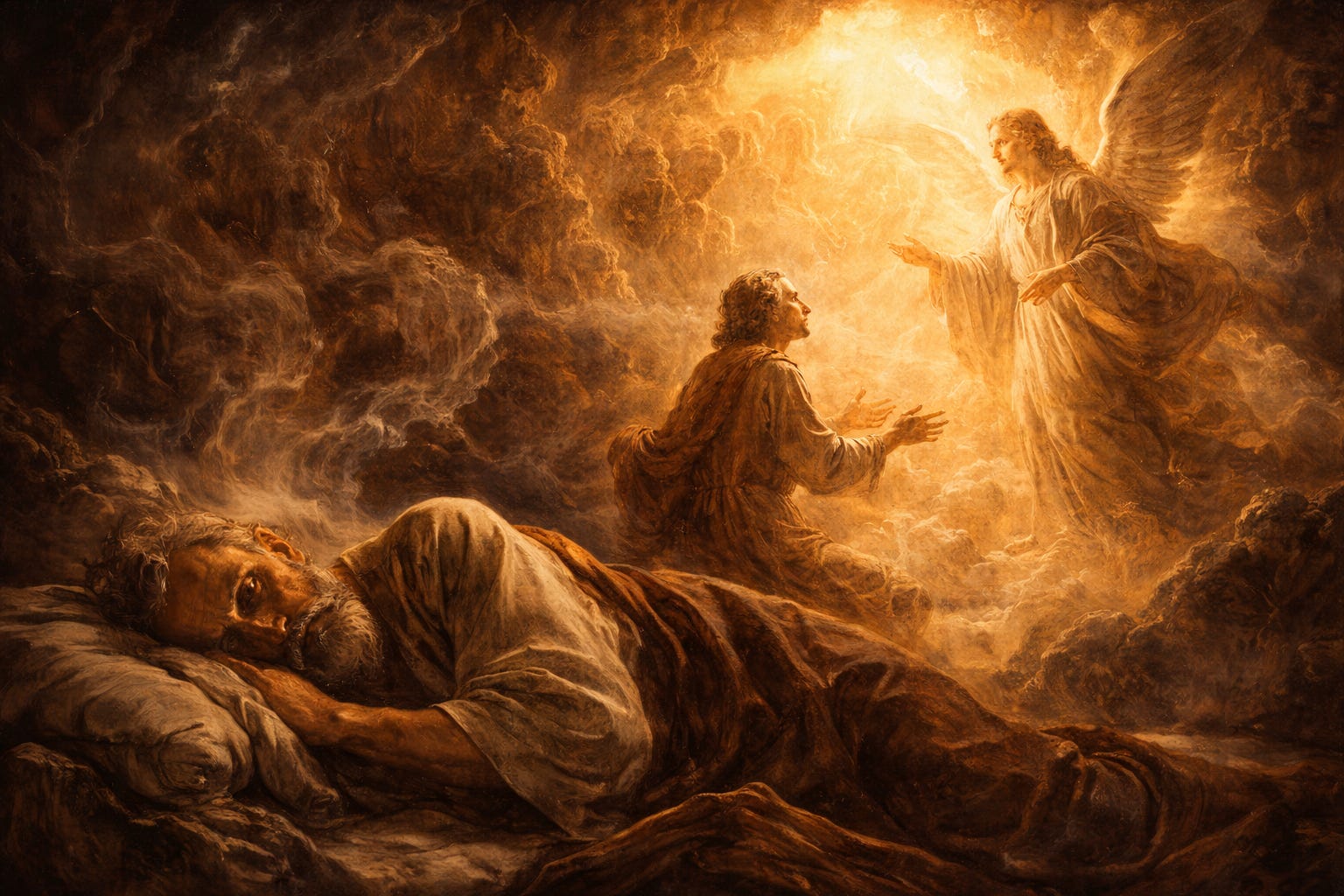
Every advanced culture before our own took dreams seriously. There were actual dream temples in Egypt, and Greek seekers used to sleep at the steps of Epidaurus hoping for visions from Asclepius. Dreams are treated as a primary channel of divine communication in the Hebrew Bible and indigenous cultures across the globe developed frameworks for dream navigation.
Synesius of Cyrene, a Neoplatonist philosopher trained by Hypatia, wrote a treatise on dreams in the fifth century, where he claimed that dreams are the most democratic form of contact with higher forms of reality as there is no requirement for a temple, priest or any kind of initiation.
And 1600 years later we reduced this to neural housekeeping and the brain taking out the trash.
That reduction deserves scrutiny because it fails to account for what actually happens when people pay attention to their dreams.
What Jung Found
Carl Jung spent many decades listening to dreams with the same rigor that a naturalist would bring to a field observation. Over half a century he documented and cross-referenced more than 10,000 of his patients’ dreams.
He found that his patients dreamed of motifs from mythologies that they had never encountered. A man that had no knowledge of alchemy produced dream imagery of medieval alchemical sequences. Even symbols from Egyptian, Hindu or Gnostic traditions would appear in the dreams of his Swiss patients that had never opened a book on religion.
Jung’s explanation for this was the collective unconscious, a layer of psychic reality that was deeper than any personal experience. This layer was populated by structures Jung called the archetypes, universal patterns that don’t belong to any individual but operate through everyone. The dreams weren’t generating random noise, they were drawing from a shared reservoir.
Jung also documented cases where the figures that appeared in some dreams would respond to the dreamer with an intelligence that the dreamer himself didn’t possess. They would offer solutions that the waking mind couldn’t find by himself, and they would correct false assumptions that the dreamer had. They behaved like independent entities operating in a shared psychic space.
Jung took this with absolute seriousness, dreams were his primary instrument and he treated them as communication to engage with. When he later developed active imagination as a way to engage with unconscious content, he described it as doing while awake what dreams do while you sleep.
What Dreams Reveal
Consider what the dream state actually is, stripped of both mystical inflation and reductive dismissal.
Your body enters its most reduced state. All your voluntary muscle control shuts down and sensory input from the physical world drops to near zero. Your ego dissolves. Everything that materialism considers necessary for consciousness is either absent or radically diminished.
And yet your consciousness continues as a vivid and structured experience. Where you encounter beings and you feel emotions with extraordinary intensity. And sometimes you even access an understanding that your waking mind can’t replicate.
This is very strange if you look at it from a materialist point of view. Because if consciousness is produced by neural computation then why does it intensify when the organ that produces the computation is at its lowest intensity? Why is the dissolution of the ego and the reduction of sensory input producing more experience rather than less?
However if you look at it from the point of view of Philip Goff and cosmopsychism it’s not that strange anymore. Because if consciousness is fundamental rather than produced and if it’s the intrinsic nature of reality rather than a byproduct then the dream state is exactly what you would predict. If you remove the body’s constant input and the filtering mechanisms of the ego what remains is consciousness less obstructed.
This reframes the entire phenomenon. The dream is consciousness operating closer to its natural state, with the ego’s interference temporarily suspended.
The Tradition Already Knew
The first book of the Corpus Hermeticum, the Poimandres, opens with what is essentially a dream. Hermes enters a contemplative state. A vast figure appears and identifies itself as Nous, divine intellect. The entire foundation of the Hermetic tradition is delivered through this channel. A visionary state indistinguishable from lucid dreaming.
The tradition placed its most foundational revelation in a dream state because it understood something about where the clearest signal originates. When the ego is out of the way, what comes through is less distorted.
Iamblichus made an explicit distinction between ordinary dreams and what he called theurgic dreams. Where ordinary dreams process daily life and theurgic dreams function as direct communication from deeper levels of reality. This is an important distinction because as every Lucid dreamer knows, some dreams are just noise while some dreams carry a weight that is different from anything the waking mind can produce.
Synesius went even further, in De insomniis he argued that dream practice should be the foundation of contemplative life because of its accessibility. You need training for meditation and prayer requires a framework of belief. Ritual requires a community and a tradition. Dreams require nothing.
Oneironautics
The word means dream navigation. And the distinction between dreaming and oneironautics is the distinction between being carried by an ocean current and learning to swim.
Most people dream passively, oneironautics begins with attention. A dream journal is the foundational tool. Writing down dreams trains the mind to remember them, and that signals to whatever generates them that you are listening. Dream recall improves fast once the practice begins. Within weeks they begin to hold its shape long enough after waking up that they can be examined.
Over time the journal will reveal patterns. Recurring figures, landscapes and emotional textures that point to something beneath the surface of daily life.
Traditions across cultures have used plants to deepen this work. Mugwort has been used for centuries in Europe to intensify dream vividness and recall. Calea zacatechichi also known as the dream herb, serves a similar function in Mesoamerican traditions. These herbs don’t alter waking consciousness, they work specifically on the dream state.
Lucid dreaming represents the mature form of the practice, where the dreamer becomes conscious within the dream without waking up. You can engage dream figures directly and explore the dream landscape with intention. You are able to ask questions and receive answers from whatever intelligence that populates that territory.
This is Jung’s active imagination performed in the dimension where it has the most direct access to what lies beneath personal consciousness.
The Invitation
The spiritual traditions that survive today have inherited sophisticated technologies for prayer, for ritual, for meditation. Contemplatives spend years learning to quiet the mind. Monastics structure their entire lives around scheduled devotion. These are serious practices and they produce serious results.
But every night, the same territory these practices struggle to access opens on its own. Consciousness enters a space populated by autonomous figures, collective symbols, and an intelligence that operates independently of your intentions. You didn’t earn this access, you can’t prevent it. It arrives on schedule whether you are a saint or have never meditated once in your life.
Synesius was right. This is the most democratic spiritual practice in existence. It asks nothing of you except that you pay attention.
Thank you for this inspiring piece. Since quitting cannabis last year, my dream recall has been significantly enhanced. I was journaling for a time but fell off the wagon. It’s easier for me to dictate to my notes in my phone rather than turn the light on and physically write. I definitely want to re engage. I have heard about using a digital watch and making a habit of checking it to see if you are dreaming because digital numbers can’t be read in the dream world. Also of flipping light switches each time you enter a room, because lighting can’t be changed in dreams. I actually noticed that in a dream recently, though I hadn’t been practicing and it didn’t fully alert me to the fact I was dreaming. Someone once told me that he lucid dreamed all the time and was always exhausted because when doing so he didn’t rest. That was the only time I’d heard that.